I was lucky enough to have the time to do one of my favourite activities one Saturday in July – take a relaxed stroll around some charity shops.
I ended up in the Lewis-Manning Hospice Care shop on Wimborne Road, Bournemouth, and was having a little mooch at the purses (I’m in the market for one since the zip on mine broke – I’m carrying it around just waiting for the day when everything falls out…!).
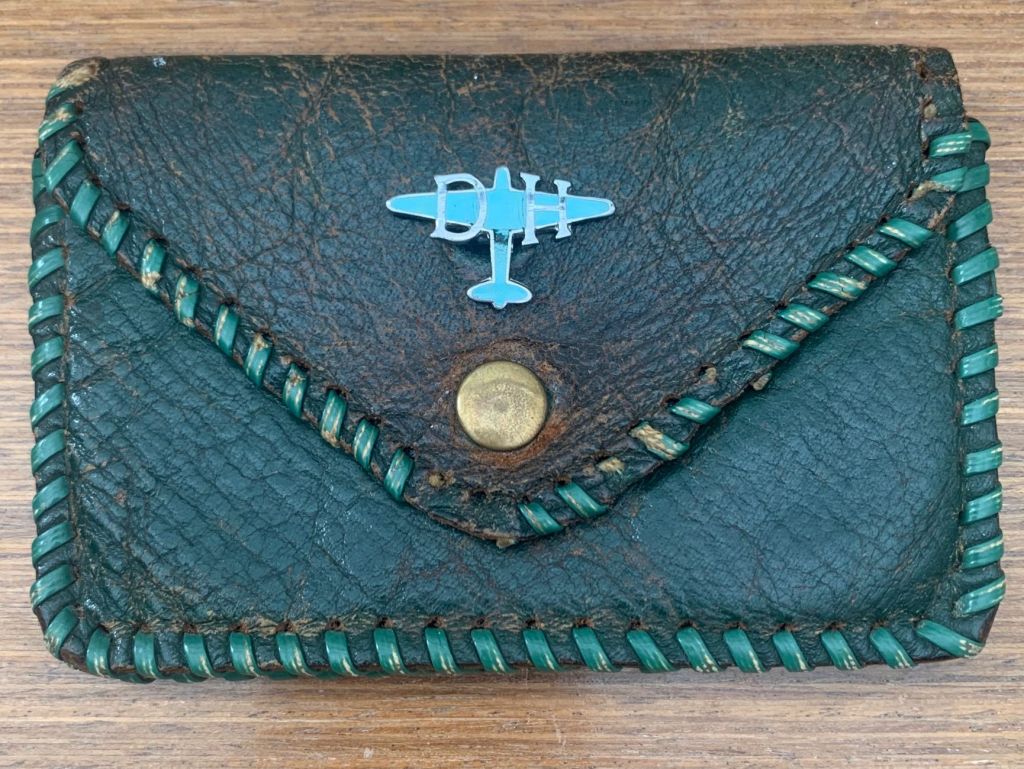
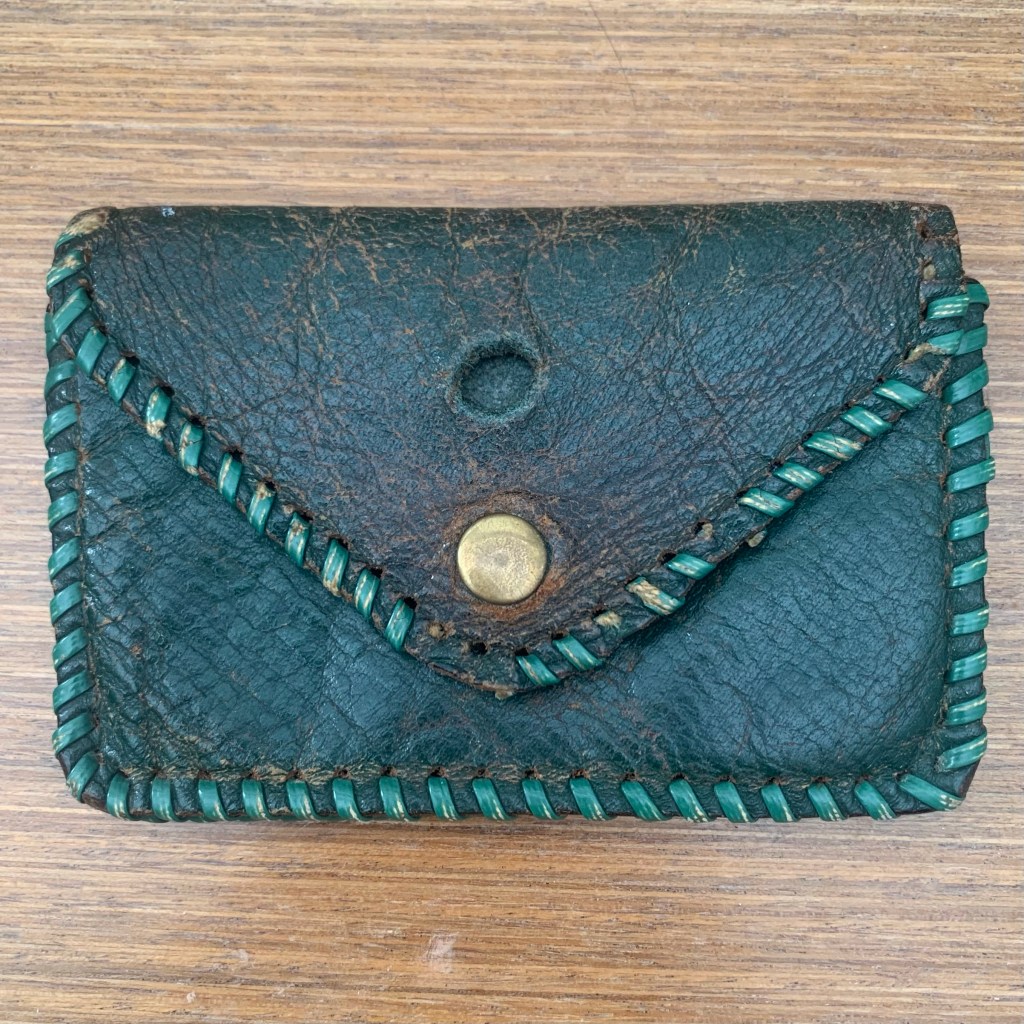
During a little poke around in their mixed basket of wallets, something caught my eye. It was a purse that was clearly a lot older than the rest of them, seemingly handmade from green leather, demonstrating a leather binding technique that I’d seen my grandparents use to make wallets and bags.
It was decorated on the front with what looked like an enamel pin, in the shape of a plane, with the letters ‘D H’ incorporated into the design.
I could tell that the plane looked quite old and it had something special about it; it certainly wasn’t just any old random piece of decoration. I Googled it whilst I was in the shop (a great technique if you’re curious about something when vintage shopping) and found it was a 1930s/1940s lapel badge, with D H standing for ‘de Havilland’ – a famous UK British aviation manufacturer.
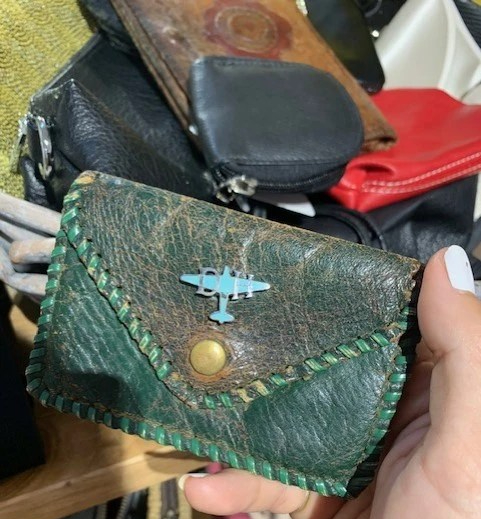
Of course I was totally enamoured, so I bought the purse for £3 and set about doing some research. Here’s what I found out:
Things that initially drew me to the purse
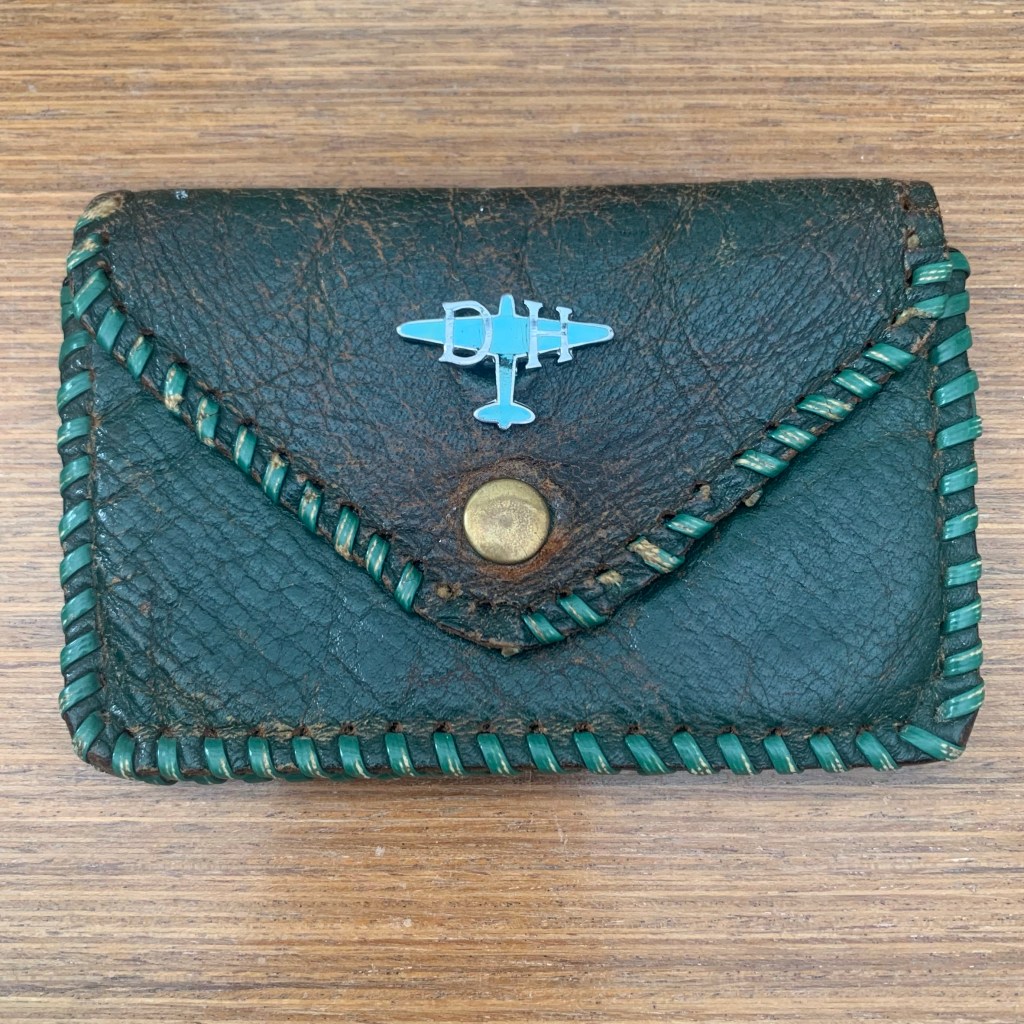
There were a few things that caught my eye straight away when looking at this purse and made me wonder about its history, so I thought I’d share them below as they’re some of the factors that made me totally fall in love with this find.
- The attention to detail – it was so interesting to me that someone had gone to the effort of specifically mounting the lapel badge onto the purse by making a hole to push it through – I’d love to know why.
- The badge itself – the back of the badge was curious; it featured a half moon metal shape instead of a traditional pin. I later discovered that this is because it was designed to go through a lapel button hole.
- The well-used aesthetic – the purse itself was clearly well loved and well used; it made me wonder if someone had used it everyday.
- Its vintage credentials – the age of the purse was so obvious straight away, and quite simply – I’m a magpie for old things.
- An illegible inscription – there were some markings on the inside of the purse (though hard to read) that clearly would reveal who it used to belong to. I love when vintage finds have a name attached – it makes them so much more personal and adds another level to potential research (unfortunately, I haven’t yet been able to decipher the inscription).

Who were de Havilland?
Established in 1920, the de Havilland Aircraft Company was a British aviation manufacturer. It was founded by Geoffrey de Havilland, an influential aircraft designer and engineer. The company played a significant role in the history of aviation, particularly during the early to mid-20th century and lead up to WWII.
Most notably, de Havilland made the world’s first commercial jet airliner (the 106 Comet). Closer to WWII, they were also responsible for manufacturing aircraft propellers for a variety of notable planes including the Hurricane and Spitfire. Safe to say, they were kind of a big deal.
De Havilland became renowned for their innovative aircraft designs, many of which made significant contributions to aviation.
What are some of de Havilland’s most notable aircraft?
- 82 Tiger Moth: Introduced in the 1930s, the Tiger Moth was a biplane trainer aircraft that played a crucial role in training pilots during World War II. It was widely used by the British Royal Air Force (RAF) and other air forces around the world.
- 88 Comet: 88 Comet was a twin-engine aircraft designed for long-distance air racing. It gained international fame when it won the MacRobertson Air Race from England to Australia in 1934 (pretty mad stuff for 100 years ago!).
- 98 Mosquito: One of the most iconic and versatile aircraft of World War II, the Mosquito was a twin-engine aircraft primarily constructed of wood (which seems ridiculous nowadays when aircraft are designed with cutting-edge lightweight metals!). It served various roles, including bomber, fighter-bomber, reconnaissance and night fighter. Its high speed and agility earned it the nickname “The Wooden Wonder.”
- 106 Comet: As mentioned, the 106 Comet was the world’s first commercial jet airliner. It entered service in 1952 and revolutionised air travel with its jet propulsion and pressurised cabin.
In 1960, de Havilland Aircraft Company merged with Hawker Siddeley Aviation to form Hawker Siddeley Group, which later became part of British Aerospace (BAe). Although the de Havilland brand is no longer active, their aircraft designs and contributions to aviation remain influential and noteworthy, which is why it’s so cool to own a part of their early history.
What is a de Havilland lapel badge?
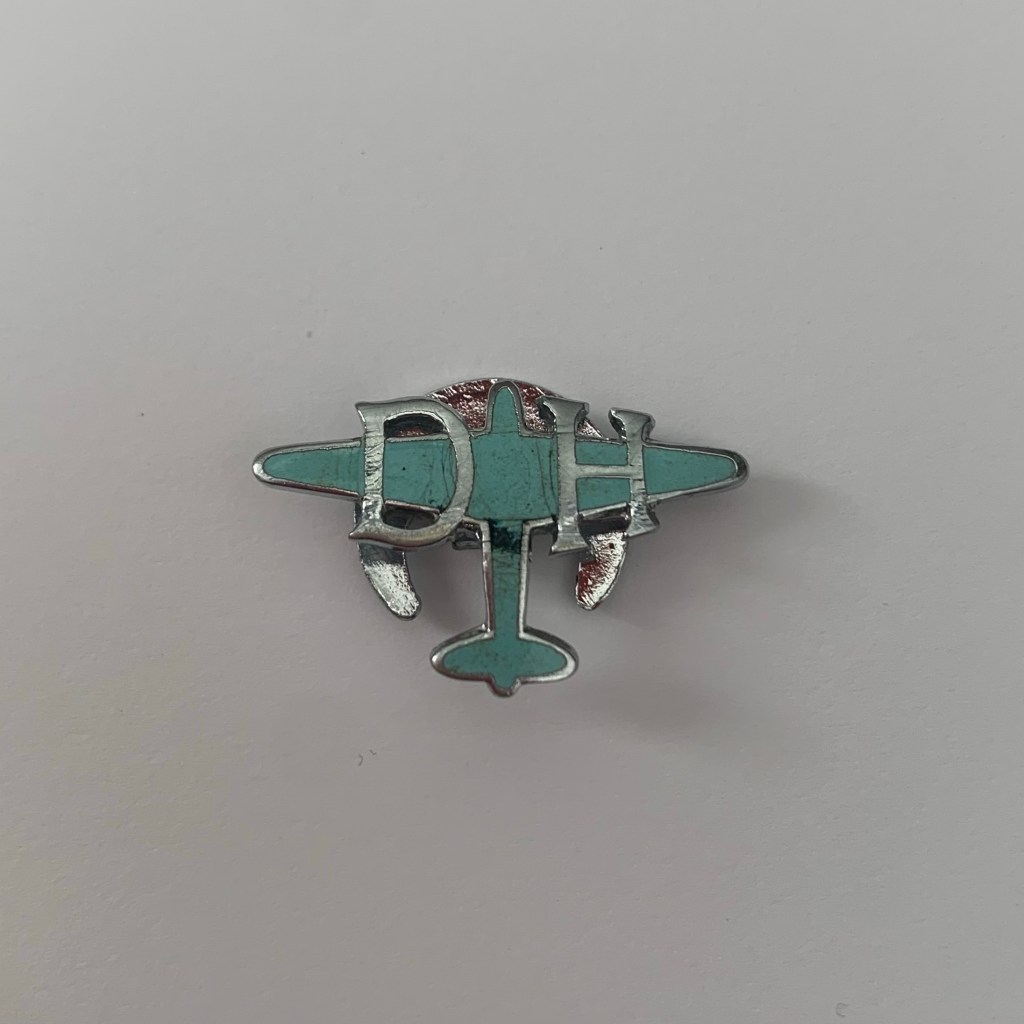
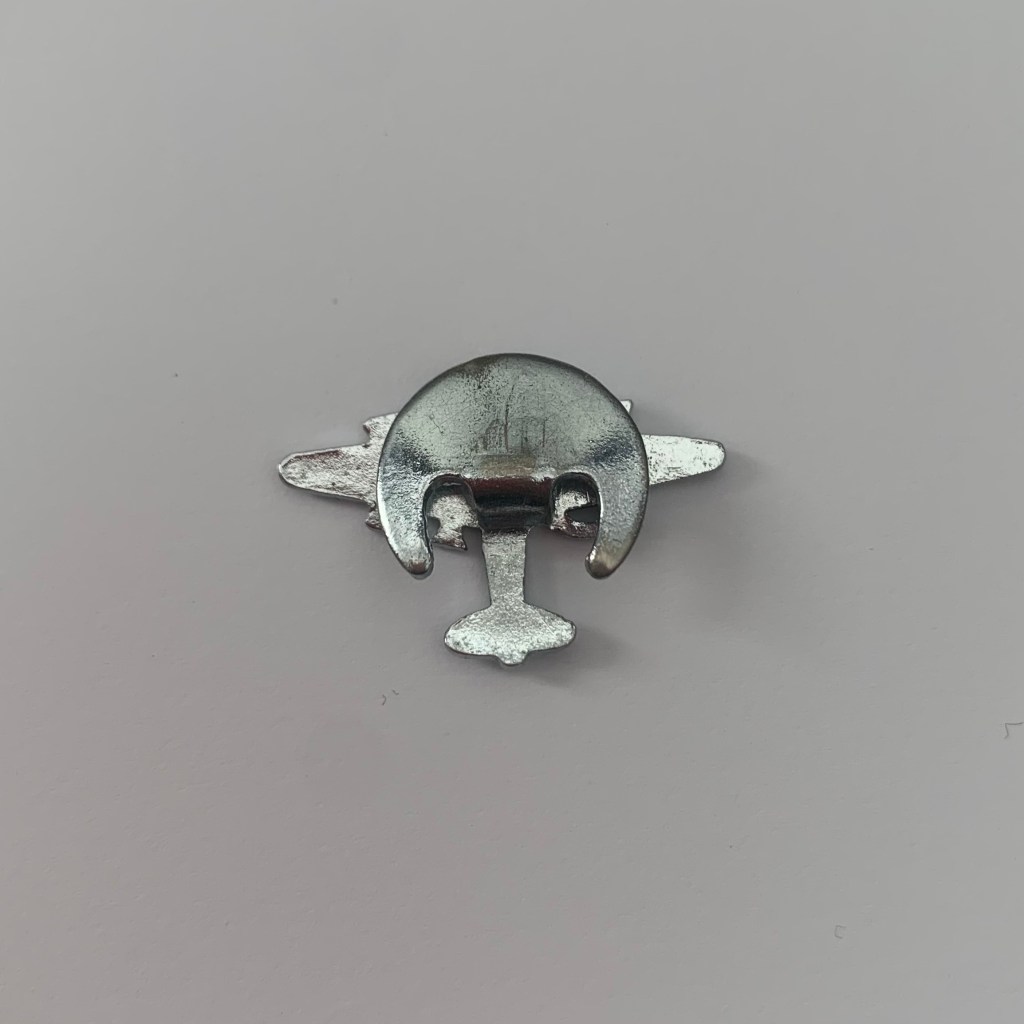
De Havilland produced a range of lapel badges in different styles, some were designed for the social club members (featuring the letters DHSC – de Havilland Social Club) whilst others were worn by workers at their factories.
The badge that I found seems to be one of those that would be worn by factory workers, slotted into the button hole of the lapel of their work overalls as part of their uniform.
This makes it even more intriguing that the purse I found had a special hole punched into it for the lapel badge – it makes me wonder if a factory worker took the purse to work everyday (which would explain the purse’s wear) and used the wallet as a way to keep their badge safe when they weren’t wearing it.
How much is a de Havilland lapel badge worth?
In good condition, a de Havilland lapel badge is worth between £30 – 50.
The badge that I found it slightly damaged as there is a small section of enamel is missing, so it is worth between £20 – 25.
Any further business?
When I had a better look at the purse at home, I realised that it wasn’t completely empty as I’d initially thought. The only thing inside was a tiny cutting from a magazine, showing half a man’s face. Weird.
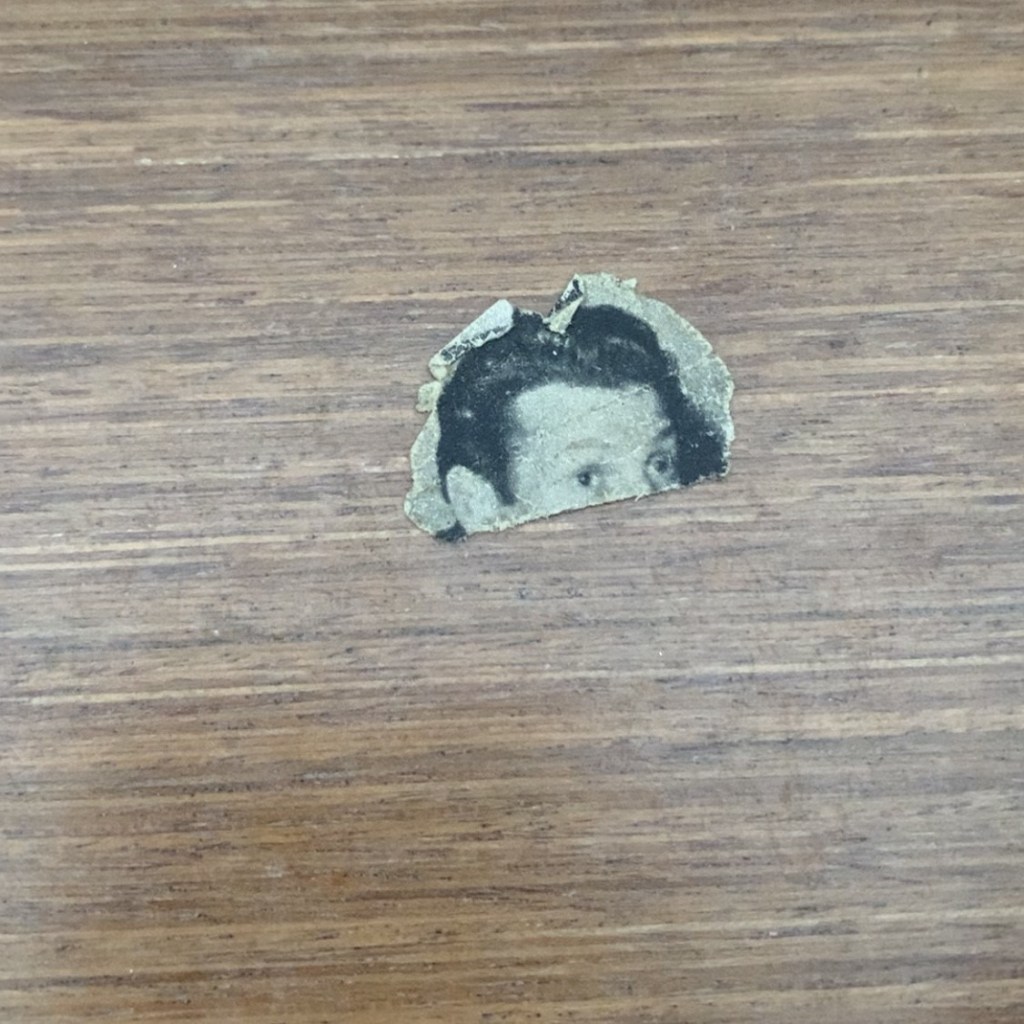
Judging by the man’s appearance and the age of the paper, I’d guess it’s from the ’40s or ’50s.
I’ve no idea why this piece of a magazine was in there, or who the man is, but it just makes me even more curious about the history of this purse and who its previous owner was. If only I could ask!
Charity shop finds that make you think
I hope you’ve enjoyed this research, spurred on by a £3 charity shop find!
Have you ever come across a de Havilland badge, or know anything about the history of the factory workers who would have worn them? I’d love to hear from you!
Also, please feel free to share your favourite charity shop (or boot sale!) find in the comments below – reading about vintage treasures is one of my favourite things.
Check out my Instagram or Etsy for more vintage gems!


 The Loop
Leave a comment